We must all ask ourselves: How do I let myself be guided by the Holy Spirit in such a way that my life and my witness of faith are both unity and communion? Do I convey the word of reconciliation and of love, which is the Gospel, to the milieus in which I live? At times it seems that we are repeating today what happened at Babel: division, the incapacity to understand one another, rivalry, envy, egoism. What do I do with my life? Do I create unity around me? Or do I cause division by gossip, criticism, or envy? What do I do? Let us think about this. Spreading the Gospel means that we are the first to proclaim and live the reconciliation, forgiveness, peace, unity, and love that the Holy Spirit gives us.
Except from The Church of Mercy by Pope Francis, pg 81
Friday, April 22, 2016

Tuesday, April 19, 2016
St. Pius Parishioner Highlight April: Forgive Offenses
This month I had the wonderful opportunity to speak with Lucy Morinelli. Last summer, while she was visiting St. Cecilia's Cathedral in Omaha, NE, Lucy was mugged and beaten by 2 young men. It was a shock to the parish to hear about this act towards one of our own and those who were able, watched in horror as the news showed the scene unfold in front of the church's security cameras. Those who knew Lucy preached the same story: Lucy was a beautiful soul who would have helped these young men if they had asked. It was no surprise to anyone when Lucy's words after the attack were words of forgiveness.
My first understanding of how special this lady was when I first called her to set up the interview. Lucy said to me over the phone that she didn't think this story was that big of a deal. Her words in the interview and even as we talked through the questions before hand were so simple: we forgive because Jesus forgives. Her witness is that simple.
As I look back on the last 5 months of witnesses from other parishioners they give us the same simple testimony: we act with mercy because Jesus Himself was merciful. Are we open to moments when we can practice mercy? Do we even recognize those moments God gives us to act with mercy?
Forgiveness can be hard to practice and for many people it is the hardest act of mercy to complete. Lucy reminds us of how freeing forgiveness is for us. When we don't forgive, it's not just the other person who is affected, but us as well. We are burdened when we do not forgive.
Let us pray this month for the graces necessary to forgive. Let us also pray to be open to moments when we can show mercy and kindness to others.
God bless!
Guest blogger:
Emily Schmid
St. Pius X Staff
Friday, April 8, 2016
Be a Saint of Mercy: Forgive Offenses…like Saint John Paul II
We’ve all been wronged by someone else. We know well the pain, anger, and suffering that these offenses cause. So we are all confronted with the consideration of how to mercifully approach forgiving someone for the wrongs they’ve committed against us? Unfortunately, there isn’t an easy answer, but lucky for us, we have saints who have modeled it well for us. And perhaps no saint modeled it more mercifully than Saint John Paul II _____________________________________________________
I don’t mean to brag, but I’ve been in the presence of a canonized saint!
Of course, if you’re over the age of 37 years old and grew up here in Iowa, chances are you have too!
 If you weren’t there in person, surely you’ve heard the story countless times over the years… On October 4th, 1979 Pope John Paul II accepted an invitation from local farmer Joseph Hays, to visit Central Iowa during his first papal visit to the United States.
Ask anyone in Urbandale, especially a St. Pius X Parishioner, about that day and you’re bound to hear the same story…
It was a cold and rainy morning. Many visitors anticipating the Pope’s visit, camped overnight on the farmland that is now Living History Farms, in the chilly and soggy conditions. Those who came the morning of the papal visit took shuttles or walked from Valley West Mall or surrounding parking areas off of I-80/35 (the interstate was closed for the papal visit). Many visitors adorned makeshift ponchos fashioned from trash bags in an attempt to stay dry. But whether arriving overnight or that morning, the wait was long and cold. But who could miss the opportunity to see the Pope in person, and in our own “backyard”?!
My parents were there.
They bundled up their little 13 month old son and made the journey from the North-side of Des Moines to the farm on the outskirts of town. The way Mom tells the story, “It was cold and rainy and we were second guessing bringing you, Joe. But the thought of missing the Pope wasn’t an option. We had to be there. It was cloudy and dreary as we waited. But then we heard it, the distant thumping of a helicopter approaching. The anticipation of the crowd began to grow, and like a miracle, the grey skies disappeared and were replaced by a beautiful sunny sky, just as the papal helicopter appeared over the horizon. It’s like the Pope brought the sun with him. It was perfect!”
Ask around, or reminisce and I promise you’ll hear the same account of that day over and over again. Holy people carry with them Jesus.
Perhaps this is what’s at the center of the Work of Mercy to Forgive Offenses. It’s an exchange of Jesus’ mercy and love from one person to another!
At least John Paul II sure seemed to approach it this way!
With our personal connection to John Paul II here in Urbandale, it makes sense to look to his example as we strive to live lives of Mercy, especially when we look to Forgiving Offenses done against us!
A few years after his historic stop in the U.S., Pope John Paul II was making his way through the throngs of visitors packing Saint Peter’s Square, when four gunshots were fired from among the waiting crowd. The date was May 13th, 1981. And Pope John Paul II found himself the target of an assassination attempt. Of the four bullets fired by young Turkish murderer, Mehmet Ali Agca, two bullets struck the Pope, wounding him in the abdomen, right arm, and left hand, as he collapsed into the hands of his personal secretary, Rev. Stanislaw, and personal servant, Angelo Gugel (the other two bullets wounded American and Jamaican tourists standing nearby).
Pope John Paul II was rushed to a nearby hospital, Gemelli Hospital, where he underwent over five hours of intense surgery, including the transfusion of nearly six pints of blood and the removal of three different sections of his intestines.
The actions of Ali Agca caused the Pope significant wounds. An offense that lead to months of surgery, recovery, and rehabilitation.
For his actions, Ali Agca was arrested and sentenced to life imprisonment in Italy – but he was eventually released.
 Following the assassination attempt, John Paul II asked people to “pray for my brother…whom I have sincerely forgiven.” In 1983, the Holy Father followed up his words with a visit to the prison where Ali Agca was being kept. The two met privately face-to-face, John Paul II forgave his would-be murderer in person!
Over the years Pope John Paul II and Ali Agca corresponded with each other. The assassin seemingly becoming a believer in the mercy and love that his target freely brought to him in the name of Jesus!
As we reflect on our Christian call to Forgive (all) Offenses, may we each find direction and joy in John Paul the Great’s response to Mehmet Ali Agca.
Saint John Paul II…Pray for Us!
I don’t mean to brag, but I’ve been in the presence of a canonized saint!
Of course, if you’re over the age of 37 years old and grew up here in Iowa, chances are you have too!
 If you weren’t there in person, surely you’ve heard the story countless times over the years… On October 4th, 1979 Pope John Paul II accepted an invitation from local farmer Joseph Hays, to visit Central Iowa during his first papal visit to the United States.
Ask anyone in Urbandale, especially a St. Pius X Parishioner, about that day and you’re bound to hear the same story…
It was a cold and rainy morning. Many visitors anticipating the Pope’s visit, camped overnight on the farmland that is now Living History Farms, in the chilly and soggy conditions. Those who came the morning of the papal visit took shuttles or walked from Valley West Mall or surrounding parking areas off of I-80/35 (the interstate was closed for the papal visit). Many visitors adorned makeshift ponchos fashioned from trash bags in an attempt to stay dry. But whether arriving overnight or that morning, the wait was long and cold. But who could miss the opportunity to see the Pope in person, and in our own “backyard”?!
My parents were there.
They bundled up their little 13 month old son and made the journey from the North-side of Des Moines to the farm on the outskirts of town. The way Mom tells the story, “It was cold and rainy and we were second guessing bringing you, Joe. But the thought of missing the Pope wasn’t an option. We had to be there. It was cloudy and dreary as we waited. But then we heard it, the distant thumping of a helicopter approaching. The anticipation of the crowd began to grow, and like a miracle, the grey skies disappeared and were replaced by a beautiful sunny sky, just as the papal helicopter appeared over the horizon. It’s like the Pope brought the sun with him. It was perfect!”
Ask around, or reminisce and I promise you’ll hear the same account of that day over and over again. Holy people carry with them Jesus.
Perhaps this is what’s at the center of the Work of Mercy to Forgive Offenses. It’s an exchange of Jesus’ mercy and love from one person to another!
At least John Paul II sure seemed to approach it this way!
With our personal connection to John Paul II here in Urbandale, it makes sense to look to his example as we strive to live lives of Mercy, especially when we look to Forgiving Offenses done against us!
A few years after his historic stop in the U.S., Pope John Paul II was making his way through the throngs of visitors packing Saint Peter’s Square, when four gunshots were fired from among the waiting crowd. The date was May 13th, 1981. And Pope John Paul II found himself the target of an assassination attempt. Of the four bullets fired by young Turkish murderer, Mehmet Ali Agca, two bullets struck the Pope, wounding him in the abdomen, right arm, and left hand, as he collapsed into the hands of his personal secretary, Rev. Stanislaw, and personal servant, Angelo Gugel (the other two bullets wounded American and Jamaican tourists standing nearby).
Pope John Paul II was rushed to a nearby hospital, Gemelli Hospital, where he underwent over five hours of intense surgery, including the transfusion of nearly six pints of blood and the removal of three different sections of his intestines.
The actions of Ali Agca caused the Pope significant wounds. An offense that lead to months of surgery, recovery, and rehabilitation.
For his actions, Ali Agca was arrested and sentenced to life imprisonment in Italy – but he was eventually released.
 Following the assassination attempt, John Paul II asked people to “pray for my brother…whom I have sincerely forgiven.” In 1983, the Holy Father followed up his words with a visit to the prison where Ali Agca was being kept. The two met privately face-to-face, John Paul II forgave his would-be murderer in person!
Over the years Pope John Paul II and Ali Agca corresponded with each other. The assassin seemingly becoming a believer in the mercy and love that his target freely brought to him in the name of Jesus!
As we reflect on our Christian call to Forgive (all) Offenses, may we each find direction and joy in John Paul the Great’s response to Mehmet Ali Agca.
Saint John Paul II…Pray for Us!
Friday, April 1, 2016
The Spiritual Act of Mercy: Forgive Offenses
Forgiveness is not something that comes easy to many. As we listen to the rhetoric on the news and
in the various political ads that are running these days there is little room
for forgiveness. Even among our
acquaintances we hear the words, “I’ll sue” if something does not go the way
one wants something to go. We hear a desire for retribution and
retaliation. We want “justice” and “what
is due to us because we have been wronged.” We may find ourselves wondering if there is a
place for forgiveness in our world.
Frankly, I believe there is.
It seems to me that we waste a lot of time and energy being angry and
bitter. Our emotions seem fragile and
our health may be compromised because we carry the burden and stress of not
forgiving.
There is a great release when forgiveness is offered and
received. Summoning the courage to
approach another and have the tough conversations is an act of faith. Daring to broach the tough issues in life
builds character in us. Extending the
olive branch of peace not knowing how it will be received takes trust…in us and
in the heart of the other, even when the heart is wounded.
Funny thing about forgiving offenses, it may be hard for us
to forgive, but it is equally as difficult for the person seeking forgiveness
to ask for it in the first place.
When we forgive offenses we not only gift the other with the
gift of peace, but we gift ourselves with the gift of freedom as well.
Guest Blogger:
Dr. Cheryl Fournier
Pastoral Associate for Life Long Faith Formation
St. Pius X Catholic Church
Friday, March 25, 2016
What Pope Francis says about "Admonish Sinner"
The light of love proper to faith can illumine the questions of our own time concerning truth. Truth nowadays is often reduced to the subjective authenticity of the individual, valid only to the life of the individual. A common truth intimidates us, for we identify it with the intransigent demands of totalitarian systems. But if truth is a truth of love, if it is a truth disclosed in personal encounter with the Other and with others, then it can be set free from its enclosure in individuals and become part of the common good. As a truth of love, it is not one that can be imposed by force; it is not a truth that stifles the individual. Since it is born of love, it can penetrate to the heart, to the personal core of each man and woman. Clearly, then, faith is not intransigent but grows in respectful coexistence with others. One who believes may not be presumptuous; on the contrary, truth leads to humility because believers know that, rather than ourselves possessing truth, it is truth that embraces and possesses us. Far from making us inflexible, the security of faith sets us on a journey; it enables witness and dialogue with all.
(Excerpt from The Church of Mercy, page 8)
Friday, March 18, 2016
St. Pius Parishioner Highlighter March: Admonish the Sinner
Ok, you caught us, this month we didn't technically interview a parishioner, but Fr. Joe is a part of our larger Church community and he is not short on words to describe God's mercy and love.
Admonish the Sinner is a difficult topic to discuss and it's hard to find practical ways to practice this Work of Mercy. How do you tell someone that they are behaving sinfully without them getting angry or defensive? Fr. Pins gives us some great advice: to not sin ourselves. The best way to admonish the sinner is to first look at ourselves. When we look at admonishing the sin in our own lives we have a better understanding of how difficult it is to change a behavior, which leads to empathy and patience for others. Then we can speak more genuinely and compassionately with others about the struggle that they experience. And Pope Francis reminds us time and time again that we must be the face of Christ to others, the face of mercy.
As we move through lent, may God bless you as you look inward to overcome sin and through the power of Jesus Christ arise victorious!
Guest Blogger:
Emily Schmid
SPX Music Ministry Director &
Adult Faith Formation Coordinator
Friday, March 11, 2016
Be a Saint of Mercy: Admonish the Sinner...like Padre Pio!
The third Spiritual Work of Mercy, Admonish the Sinner, is one that most Catholics either misunderstand, cringe at, or completely ignore when acting on our call to live the Works of Mercy. Let's admit it, it's easy to talk to ourselves into believing that Feeding the Hungry is more important and urgent than Admonishing the Sinner...plus it seems to require less awkward interactions!
Before moving on, perhaps it's wise to begin with a little explanation of what it really means to "Admonish the Sinner."
In Matthew 18:15-18 Jesus said, "If your brother sins against you, go and tell him his fault, between you and him alone. If he listens to you, you have gained your brother. But if he does not listen, take one or two others along with you, that every word may be confirmed by the evidence of two or three witnesses. If he refuses to listen to them, tell it to the church; and if he refuses to listen even to the church, let him be to you as a Gentile and a tax collector. Truly, I say to you, whatever you bind on earth shall be bound in heaven, and whatever you loose on earth shall be loosed in heaven."
In our world, "Admonishing the sinner" is often confused and used interchangeably with judging or condemning somebody for his or her actions. But if you read Jesus' words in Matthew 18 closely, you'll see that admonishing has nothing to do with judging someone, but everything to do with genuinely loving them! But, we know from experience that it isn't always easy to lovingly correct someone-our message doesn't always carry the love we hold in our hearts and our intentions can so easy be misinterpreted! But again, Jesus' instruction in Matthew 18 points out the difference...He instructs us to seek out our "brother" in private! This really gets to the heart of "Admonishing the Sinner." how do we correct the sinner? What is our intent? What is our approach? Are we more concerned with the soul of the sinner or punishing them for the evil done? We have to weigh our intentions carefully and take our concerns for the soul of our friend and strangers into consideration, before we speak!
So what saint should we turn to this March? Who can model for us an authentic example of "Admonishing the Sinner?"
How about the tremendous mystic monk, Padre Pio!
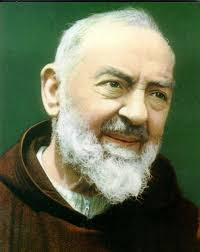 Padre Pio, baptized Francesco Forgione, grew up and lived in Italy between 1887 and 1968. At the age of ten he told his parents, "I want to be a friar...with a beard," after seeing a Capuchin friar traveling through town. These genuine words would end up being prophetic, as Francesco was ordained a priest on August of 1910. Within a month of his ordination, Padre Pio found himself praying in a a chapel when Jesus and Mary appeared to him and gifted him the wounds of Christ on the Cross, the stigmata! This began years of ecstasies, illness, suffering, and other miraculous displays of God's work through Padre Pio.
During his assigned time in San Giovanni Rotondo, Padre Pio became the spiritual father for many men and women (called his spiritual daughters and sons). Padre Pio shared with these daughters and sons his five rules for spiritual growth-1. Weekly Confession, 2. Daily Communion, 3. Spiritual Reading, 4. Meditation and 5. Examination of Conscience. When explaining these spiritual rules, Padre Pio used the analogy of dusting a room (used or unused) on a weekly basis, to frequent confession.
And it was after establishing this private relationship with his spiritual children that Padre Pio began to share with them his God-given gift of seeing the soul with interior vision. With his holy eyes he could see the dark corners of this "undusted" room that he spoke of. It allowed Padre Pio the opportunity to admonish those hidden sins that his spiritual children (and all humanity) like to keep hidden.
For example, from the book "The Padre: Testimonies" by Fr. Iasenzaniro we read...
Padre Pio cared about the souls that crossed his path, even when it was a soul that had much dust to clean. He yearned for these souls to experience the grace and love that only comes through a relationship with Jesus Christ. Do we approach dusty rooms with the same desire!? Padre Pio models perfectly the way to "Admonish the Sinner."
If you would like to learn more about Padre Pio, I suggest checking out this website: http://padrepiodevotions.org
If you desire to become one of Padre Pio's spiritual children, consider saying this prayer:
O Saint Padre Pio,
holy bearer of the Wounds of Christ,
accept us this day as your spiritual sons and daughters and keep us
always on the narrow path
by your intercession.
And do thou, O our Spiritual Father,
stay there at the Gates of Heaven until
all of your spiritual children have entered
through, even and including us.
Through Christ our Lord,
Amen.
As we reflect on our Christian call to "Admonish the Sinner," may we each find compassion and love in the way Padre Pio approached sinners. He models for us the love that must be at the forefront of our desire to correct others.
Saint Padre Pio...Pray for us!
Guest blogger: Joe Tallman
SPX School Middle School Religion
Before moving on, perhaps it's wise to begin with a little explanation of what it really means to "Admonish the Sinner."
In Matthew 18:15-18 Jesus said, "If your brother sins against you, go and tell him his fault, between you and him alone. If he listens to you, you have gained your brother. But if he does not listen, take one or two others along with you, that every word may be confirmed by the evidence of two or three witnesses. If he refuses to listen to them, tell it to the church; and if he refuses to listen even to the church, let him be to you as a Gentile and a tax collector. Truly, I say to you, whatever you bind on earth shall be bound in heaven, and whatever you loose on earth shall be loosed in heaven."
In our world, "Admonishing the sinner" is often confused and used interchangeably with judging or condemning somebody for his or her actions. But if you read Jesus' words in Matthew 18 closely, you'll see that admonishing has nothing to do with judging someone, but everything to do with genuinely loving them! But, we know from experience that it isn't always easy to lovingly correct someone-our message doesn't always carry the love we hold in our hearts and our intentions can so easy be misinterpreted! But again, Jesus' instruction in Matthew 18 points out the difference...He instructs us to seek out our "brother" in private! This really gets to the heart of "Admonishing the Sinner." how do we correct the sinner? What is our intent? What is our approach? Are we more concerned with the soul of the sinner or punishing them for the evil done? We have to weigh our intentions carefully and take our concerns for the soul of our friend and strangers into consideration, before we speak!
So what saint should we turn to this March? Who can model for us an authentic example of "Admonishing the Sinner?"
How about the tremendous mystic monk, Padre Pio!
 Padre Pio, baptized Francesco Forgione, grew up and lived in Italy between 1887 and 1968. At the age of ten he told his parents, "I want to be a friar...with a beard," after seeing a Capuchin friar traveling through town. These genuine words would end up being prophetic, as Francesco was ordained a priest on August of 1910. Within a month of his ordination, Padre Pio found himself praying in a a chapel when Jesus and Mary appeared to him and gifted him the wounds of Christ on the Cross, the stigmata! This began years of ecstasies, illness, suffering, and other miraculous displays of God's work through Padre Pio.
During his assigned time in San Giovanni Rotondo, Padre Pio became the spiritual father for many men and women (called his spiritual daughters and sons). Padre Pio shared with these daughters and sons his five rules for spiritual growth-1. Weekly Confession, 2. Daily Communion, 3. Spiritual Reading, 4. Meditation and 5. Examination of Conscience. When explaining these spiritual rules, Padre Pio used the analogy of dusting a room (used or unused) on a weekly basis, to frequent confession.
And it was after establishing this private relationship with his spiritual children that Padre Pio began to share with them his God-given gift of seeing the soul with interior vision. With his holy eyes he could see the dark corners of this "undusted" room that he spoke of. It allowed Padre Pio the opportunity to admonish those hidden sins that his spiritual children (and all humanity) like to keep hidden.
For example, from the book "The Padre: Testimonies" by Fr. Iasenzaniro we read...
"Father Pasquale Cattaneo also gives us a testimony showing Padre Pio's ability to read hearts. Fr. Cattaneo had received permission from his superiors to visit San Giovanni and to go to confession to padre Pio. During his bus trip he prepared himself with a good examination of his conscience so as to be ready to make a sincere confession of his sins. With the help of the Holy Spirit he looked into every corner of his soul, and made new promises of amendment. However as the bus going to the Gargano was on the last part of the journey and the town came into view, he ended his examination perplexed thinking: "The spiritual life at times seems like trying to climb glass."
When he arrived at the friary, he went into the sacristy and told the friar who helped with the confessions that he had come to confess to Padre Pio and afterwards he patiently waited for his turn. When the time came he entered the confessional, greeted Padre Pio and made his confession. After confessing his faults, Padre Pio gave him absolution. He then arose, feeling happy that he had made a sincere confession, when he turned one last time and glanced at the Padre--the Padre smiled at him and with an amused look he wittingly said: "So the spiritual life seems like climbing glass, eh?"
Father Pasquale was flabbergasted and couldn't seem to utter a word, but from then on he was absolutely convinced that Padre Pio was enlightened by the Holy Spirit to guide souls. Thus it is a very unusual truth that P. Pio could at times perceive what his spiritual children were thinking, even without them giving explanations to him."
Padre Pio cared about the souls that crossed his path, even when it was a soul that had much dust to clean. He yearned for these souls to experience the grace and love that only comes through a relationship with Jesus Christ. Do we approach dusty rooms with the same desire!? Padre Pio models perfectly the way to "Admonish the Sinner."
If you would like to learn more about Padre Pio, I suggest checking out this website: http://padrepiodevotions.org
If you desire to become one of Padre Pio's spiritual children, consider saying this prayer:
O Saint Padre Pio,
holy bearer of the Wounds of Christ,
accept us this day as your spiritual sons and daughters and keep us
always on the narrow path
by your intercession.
And do thou, O our Spiritual Father,
stay there at the Gates of Heaven until
all of your spiritual children have entered
through, even and including us.
Through Christ our Lord,
Amen.
As we reflect on our Christian call to "Admonish the Sinner," may we each find compassion and love in the way Padre Pio approached sinners. He models for us the love that must be at the forefront of our desire to correct others.
Saint Padre Pio...Pray for us!
Guest blogger: Joe Tallman
SPX School Middle School Religion
Subscribe to:
Posts (Atom)