Friday, January 22, 2016

In the Year of Mercy: Love God, Love Others, Make Disciples, Restor All Things in Christ


As the Catholic Church throughout the world begins to celebrate the Year of Mercy, I cannot help but ponder how we do that here at St. Pius X.  Mercy is something that is rooted in who we are as a community of faith.  Yet, I must ask, do we see mercy in ourselves, in our words, in our actions?

The word mercy has its roots in the Latin, Misericordia; miserere, “to pity” and cor, meaning heart.  When we consider heart-pity, we come to another way of looking at situations and people all around us.  Our hearts look with loving-kindness on those who are suffering, whether that is in body or spirit, and often times the suffering they endure is both in body and in spirit.

Pope Francis has called us all in this next year to look with loving-kindness, with mercy, on all we encounter.  Additionally, he has asked us to focus on the Corporal and Spiritual Works of Mercy as we interact with each other and reach out to those in most need among us.

As I consider our parish mission statement, “Love God, Love Others, Make Disciples, Restore All Things in Christ,” I cannot help but see a natural connection to the Year of Mercy as well as the Works of Mercy.  When we love God, our very posture is one that restores dignity to others.  We seek to see every other being as another “made in the image and likeness of God.”  Our very encounter with each other ought to be in response to the love of God in our hearts.

Love others, showing others the goodness and kindness of God, perhaps especially when it is difficult, is what each of us is called to in response to the baptism we share.  When we became new creations in the waters of baptism, we clothed ourselves with Christ, and in doing so, we took it upon ourselves to be as Jesus for others.  Our acts of loving-kindness; feed the hungry, give drink to the thirsty, clothe the naked, welcome the stranger, visit the sick, visit the imprisoned, bury the dead, counsel the doubtful, instruct the ignorant, admonish the sinner, pray for the living and the dead, comfort the sorrowful, forgive offenses, and bear wrongs patiently, are indeed the ways we show not only our love of others, but also our love of God.  

Our actions ought to draw others closer to God.  The way we live and interact with each other ought to be a sign and symbol of life, of love, of faith.  We are to be the Good News seen and heard through our words, our witness, our living. Living as disciples, that is, as people who choose to follow in the way  of Jesus, who live what we believe, and strive to grow in our relationship with Jesus, others will be drawn to us even more.  Thus, by our witness, we make disciples; we call each other to greater growth and love of God and other people, and through our efforts at building relationships, we invite others to join us in the journey.

As the journey unfolds, as we encounter all that is around us, as we come to know God’s loving-kindness in our relationship with God, with others, with our community, who we are and what we do, we restore all things in Christ, who came that “we might have life and have it to the full.”

This jubilee year is perhaps, a time for us to live into our mission.  A time for sharing the love of God; witnessing to loving-kindness, and restoring to Christ all that has been given to us, namely, hope, peace, joy, love, in a word, mercy.

Blogger: Dr. Cheryl J. Fournier, SPX Pastoral Associate for Life-Long Faith Formation

Saturday, January 16, 2016

January Work of Mercy: Bear Wrongs Patiently


This month I had the honor of speaking with St. Pius parishioner Terry Nielsen.  I had met him casually through his service to the parish and him stopping by our office, but this was the first time I had a chance to meet with him one on one and listen to his story. His name came up with the staff for this Work of Mercy because they had heard him tell stories about being a police officer and knew already some of his stories of mercy.

One thing that struck me about Terry was something Terry said off the camera  He mentioned how normal it was for him to be around those who were in prison since he lived in the jail with his brother, a sheriff, who had adopted him as a young boy.  Terry would take prisoners their food.  As he described his level of ease working with people who, in societies mind, warranted some level of caution to be around, it occurred to me that God had shaped Terry for his service from a very young age. This was his charsim, his gift, his ministry and God was preparing him all through his life.

This month I encourage us all to not only bear wrongs patiently, but also see how God has been forming us from the beginning to be an example of mercy.  What gifts do you already posses that incline you to mercy?  When we recognize our God given gifts, it can surprise us to see how natural mercy can be.

God bless!

Blogger: Emily Schmid, SPX Staff

Friday, January 8, 2016

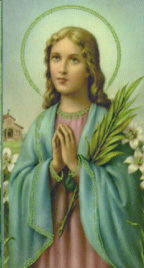
Be a Saint of Mercy! Bearing Wrongs Patiently…like Maria Goretti


Image of St. Maria GorettiMaria’s story is one that resonates with Catholics young and old. Probably because we wish we could be as faithful as she was!

Maria’s early life wasn't all that different than the normal life of most rural Iowans in the early 1900's. Maria’s parents and older siblings farmed, while she stayed at home and cared for the younger children. Life was not easy, but the simple life brought many joys. But her joyful and carefree life was interrupted by hardship when Maria’s father died when she was only nine years old.

Out of necessity life changed quickly. Maria’s mother moved the family in with a family friend and his 20 year old son, Alessandro. Maria’s second great hardship came when older Alessandro began to show interest in Maria. But each of Alessandro’s advances was quickly rejected by Maria, who had a deep desire to live a pure and chaste life. But Maria’s rejections only seemed to fuel Alessandro’s desires. So Maria did all she could to never be alone with her older admirer.

One day, when Maria’s mother and older siblings were working in the fields, Alessandro approached the twelve year old Maria as she completed her daily chores around the house. This time Alessandro didn’t stop when Maria objected to his advances, rather, this rejection quickly turned into a deep and dark rage within the young man. As Maria fought off his advances, Alessandro let his rage show. He drew his knife and stabbed helpless Maria 14 times, leaving her for dead.

Maria's third great hardship came as she suffered from her wounds for the next 24 hours. But as great saints so often do, Maria did not allow her hardships to dictate her life. During her suffering Maria received the Body of Christ and forgave her murderer. Maria died that day in the presence of her mother and siblings.

Ultimately, Alessandro was found guilty of murdering Maria and spent the next 30 years of his life behind bars. In prison, Alessandro came to see the faults in the way he was living his life. He had a dream, in which, Maria appeared to him, showering him with lilies (a symbol of purity). After his release from prison, Alessandro went immediately to Maria’s mother and begged for her forgiveness.

Maria was canonized a Saint in 1950 by Pope Pius XII. Both Maria’s mother and Alessandro were in attendance at the ceremony.

For the first time ever Maria's major relics were publicly venerated here in the United States as her incorruptible body traveled from New Jersey to St. Louis during 2015. They called this event the Pilgrimage of Mercy! You can read more about this great saint here: http://mariagoretti.com/

As we reflect on our Christian call to Bear Wrongs Patiently, may we each find strength in Maria’s response to her hardships and suffering. May we all be Saints of Mercy like Maria!

Saint Maria Goretti…Pray for Us!

Guest Blogger: Joe Tallman
Middle School Religion
Saint Pius X School

Thursday, December 31, 2015

Year of Mercy Parishioner Highlight: Feed the Hungry


This month I had the opportunity to interview Jim and Connie Cade, and Tim Huckaby about their work with the Salavation Army Casserole ministry.  This ministry consists of parishioners making casseroles that the Salvation Army then serves off a truck to people who are homeless in the Des Moines area. As I listened to these three talk about their service and work with this ministry I was humbled not by the work they were doing but by the attitudes they had about the people they served. These people loved the people they served.  I saw, by listening to their stories and experiences, how they actively loved others and then saw the fruits of that love. Tim states in the video that he liked the "directness" of this ministry; he is not just writing a check and wondering where the money goes but has direct contact with those whom he serves.  Pam shares her story of meeting a person who benefited from this casserole and the amazement with seeing the outcome of their work. Jim beautifully and simply reminds us that we are all charged to follow in Christ's example.

I have always found it rather cliche in our society to "feed the hungry."  In college, serving at the soup kitchen was the easiest way to get service hours or for a Christian group to serve the community.  I saw so many people go at it halfheartedly that I had started to become disenchanted with the idea.  This interview provided me with a living example of people who genuinely see Christ in the people they serve.  They see this ministry as their charge by God, it is a calling.  Through the living out this Work of Mercy they are united with Christ in their actions and thoughts.  Thank you to the Salvation Casserole Ministry at St. Pius for the work you do in Feeding the Hungry.

Blogger: Emily Schmid

Friday, December 25, 2015

YEAR OF MERCY

What Pope Francis says about 

Feeding the Hungry and Clothing the Naked


Excerpt from Church of Mercy by Pope Francis, pages 23-24
 
Each individual Christian and every community is called to be an instrument of God for the liberation and promotion of the poor, and for enabling them to be fully a part of society.  This demands that we be docile and attentive to the cry of the poor and come to their aid...The Church has realized that the need to heed this plea is itself born of the liberating action of grace within each of us, and thus it is not a question of a mission reserved only for a few. "The Church guided by the Gospel of mercy and by love for humankind, hears the cry for justice and intends to respond to it with all her might." In this context we can  understand Jesus' command to his disciples: "You yourselves give them something to eat!" (Mark 6:27)...

...God shows the poor "his first mercy."  This divine preference has consequences for the faith life of all Christians, because we are called to have "this mind...which was in Jesus Christ" (Phil. 2:5). Inspired by this, the Church has made an option for the poor, which is understood as a "special form of primacy in the exercise of Christian charity, to which the whole tradition of the Church bears witness.  "This option-as Benedict XVI has taught-"is implicit in our Christian faith in a God who became poor for us, so as to enrich us with his poverty."  

Friday, December 11, 2015

December Question of the Month

Each month during the Year of Mercy, we will be asking our parish a question to help them reflect on their faith journey. Please feel free to answer lovingly in the comment section.  For December we will be focusing on the two Works of Mercy: feeding the hungry and clothing the naked.  Consider these Works of Mercy as you reflect on these questions.  Visit our website www.stpiushome.org/mercy to take an opinion poll on how you practice mercy and for more information on the Jubilee Year of Mercy at St. Pius and around the world.  Stay connected through social media and follow us on Facebook and Twitter.  We at St. Pius wish you a happy Year of Mercy!

1. How do you (and your family) live our parish mission statement?
           Love God. Love Other. Make Disciples. Restore all things in Christ.

2. How do you show your love of God and love of others?

3. What gifts have you been given that you use for the good of others?

4. How do you show MERCY to member of your family; to people you do not know?

Sunday, November 29, 2015

What is the Jubilee Year of Mercy?

Jesus Christ is the face of the Father’s mercy. ... We need constantly to contemplate the mystery of mercy. It is a wellspring of joy, serenity, and peace. Our salvation depends on it…  Mercy: the bridge that connects God and man, opening our hearts to the hope of being loved forever despite our sinfulness…
At times we are called to gaze even more attentively on mercy so that we may
become a more effective sign of the Father’s action in our lives. 
For this reason I have proclaimed an Extraordinary Jubilee of Mercy as a special time for the Church, a time when the witness of believers might grow stronger and more effective. 
~ Pope Francis


Pope Francis has announced the celebration of an "extraordinary Holy Year". This "Jubilee of Mercy" will commence with the opening of the Holy Door in St. Peter’s on the Solemnity of the Immaculate Conception, 2015, and will conclude on November 20, 2016 with the Solemnity of Our Lord Jesus Christ, King of the Universe. At the start of the New Year, the Holy Father stated: "This is the time of mercy. It is important that the lay faithful live it and bring it into different social environments. Go forth!" The theme for this year has been taken from the Letter of St. Paul to the Ephesians, "God rich in mercy" (Eph 2:4).

The opening of this next Jubilee will take place on the fiftieth anniversary of the closing of the Second Vatican Council in 1965. This is of great significance, for it impels the Church to continue the work begun at Vatican II.

In the ancient Hebrew tradition, the Jubilee Year, which was celebrated every 50 years, was meant to restore equality among all of the children of Israel, offering new possibilities to families which had lost their property and even their personal freedom. In addition, the Jubilee Year was a reminder to the rich that a time would come when their Israelite slaves would once again become their equals and would be able to reclaim their rights. "Justice, according to the Law of Israel, consisted above all in the protection of the weak" (St. John Paul II, Tertio millenio adveniente 13).

The Catholic tradition of the Holy Year began with Pope Boniface VIII in 1300. Boniface VIII had envisioned a Jubilee every century. From 1475 onwards – in order to allow each generation to experience at least one Holy Year – the ordinary Jubilee was to be celebrated every 25 years. However, an extraordinary Jubilee may be announced on the occasion of an event of particular importance.

Until present, there have been 26 ordinary Holy Year celebrations, the last of which was the Jubilee of 2000. The custom of calling extraordinary Jubilees dates back to the XVI century. The last extraordinary Holy Years, which were celebrated during the previous century, were those in 1933, proclaimed by Pius XI to celebrate XIX hundred years of Redemption and in 1983, proclaimed by John Paul II on the occasion of the 1950 years of Redemption.

The Catholic Church has given to the Hebrew Jubilee a more spiritual significance. It consists in a general pardon, an indulgence open to all, and the possibility to renew one’s relationship with God and neighbor. Thus, the Holy Year is always an opportunity to deepen one’s faith and to live with a renewed commitment to Christian witness. With the Jubilee of Mercy, Pope Francis focuses attention upon the merciful God who invites all men and women to return to Him. The encounter with God inspires in one the virtue of mercy.

Mercy is a theme very dear to Pope Francis, as is expressed in the episcopal motto he had chosen: "miserando atque eligendo". One possible translation of this motto is "With eyes of mercy".

During the Year of Mercy, the Church offers a number of ways of receiving, sharing, and celebrating the graces of God’s mercy through rituals, prayers, and actions. These include some of the following:


Holy Door of Mercy – Pilgrimage and Prayer for Jubilee Indulgence

The initial rite of the Jubilee is the opening of the Holy Door. This door is one which is only opened during the Holy Year and which remains closed during all other years. Each of the four major basilicas of Rome has a Holy Door: Saint Peter’s, St. John Lateran, St. Paul Outside the Walls and St. Mary Major. This rite of the opening of the Holy Door illustrates symbolically the idea that, during the Jubilee, the faithful are offered an "extraordinary pathway" towards salvation. The Holy Doors of the other Basilicas will be opened after the opening of the Holy Door of St. Peter’s Basilica. Every diocese around the world will have one or more Holy Doors available for pilgrimage and prayer as well. The Diocese of Des Moines has designated a number of doors throughout the diocese where people can visit to receive an indulgence through the church.

An indulgence is the remission before God of the temporal punishment due sins already forgiven as far as their guilt is concerned and for which a person obtains absolution through confession. Indulgence is therefore an act of the Church’s jurisdiction and allows baptized faithful who have confessed, taken communion and completed all acts required of them, to cancel the debt of “temporal punishment” which would otherwise be purged in purgatory.

This special grace is also offered to those who are unable to travel, especially the sick, homebound, and Imprisoned. The indulgence can be directed by a person to be applied to the deceased.


Sacrament of Confession

Throughout the Year of mercy, the faithful are encouraged to celebrate God’s mercy through the Sacrament of Penance. Priests and parishes will be offering special opportunities to celebrate God’s forgiveness. Pope Francis has asked that priests around the world open churches for an extended period of time for making the celebration of the Sacrament of Reconciliation more available. This special opportunity, during the season of Lent, has been designated “24 Hours for the Lord” and will be held on March 4 & 5, 2015.


Catholics Come Home

Beginning in Lent, the Diocese of Des Moines will be reaching out to those who have left the practice of the Catholic faith or those who are unevangelized. Through media outreach, people will be welcomed and invited to seek the healing power of Christ.


Spiritual and Corporal Works of Mercy

In addition to receiving the many graces of God during the year, the faithful are called to be instruments of mercy to others through sharing in the spiritual and corporal works of mercy. Through these acts we not only extend the love of God to others, but also grow in holiness ourselves. Over the next year our parish will offer opportunities for parishioners to learn about and grow in the practice of these merciful works.


Corporal Works of Mercy      Spiritual Works of Mercy
1. Feed the Hungry                  1. Counsel the Doubtful
2. Give Drink to the Thirsty      2. Instruct the Ignorant
3. Clothe the Naked                 3. Admonish the Sinner
4. Welcome the Stranger         4. Pray for the Living and the Dead
5. Visit the Sick                        5. Comfort the Sorrowful
6. Visit the Imprisoned             6. Forgive Offenses
7. Bury the Dead                      7. Bear Wrongs Patiently